Rajiv Chowk Metro Station: An Overview
Rajiv Chowk Metro Station: The Heart of Delhi Metro Connectivity
Rajiv Chowk Metro Station is not just a transit stop; it is the lifeline of New Delhi. Situated directly underneath the iconic Connaught Place (CP), it serves as the busiest interchange hub connecting the Yellow Line (Samaypur Badli to Millennium City Centre Gurugram) and the Blue Line (Dwarka Sector 21 to Noida Electronic City/Vaishali).
Whether you are a daily commuter, a tourist visiting CP, or a shopper heading to Palika Bazar, this comprehensive guide covers everything you need to know about Rajiv Chowk Metro Station in 2025.
🚄 Quick Station Facts
| Feature | Details |
|---|---|
| Station Code | RCK |
| Location | Connaught Place, New Delhi |
| Lines Served | 🟡 Yellow Line & 🔵 Blue Line |
| Structure | Underground (Two Levels) |
| Daily Footfall | ~2.5 Lakh+ Passengers |
| ATM Facilities | PNB, SBI, HDFC (Concourse Level) |
📍 Location & Connectivity
Knowing exactly where to go can save you from wandering around the massive Connaught Place circles.
- Official Address: Rajiv Chowk Metro Station, Block B, Connaught Place, New Delhi, Delhi 110001
- Key Landmark: The station is located directly underneath Central Park.
How to Reach:
- By Bus: The nearest bus stops are Palika Kendra, Shivaji Stadium, and Marina Hotel. Frequent DTC buses connect these stops to the rest of the city.
- By Train: New Delhi Railway Station (NDLS) is just 1 metro station away (via Yellow Line towards Samaypur Badli) or a quick 10-minute auto-rickshaw ride.
- By Car/Cab: Drop-off points are available at the Inner Circle or Outer Circle. The most convenient drop-offs are near Gate 1 (B Block) or Gate 7 (A Block).
🚇 Interchange Guide: Yellow Line vs. Blue Line
Rajiv Chowk is designed with two underground levels to manage its massive crowd. Knowing which level to go to can save you precious time.
Level 1 (Upper Level): Blue Line
- Platform 3: Towards Noida Electronic City / Vaishali
- Platform 4: Towards Dwarka Sector 21
Level 2 (Lower Level): Yellow Line
- Platform 1: Towards Millennium City Centre Gurugram
- Platform 2: Towards Samaypur Badli
Pro Tip: If you are changing lines, follow the colored footsteps on the floor. Use the escalators located in the middle of the platforms for the quickest transfer.
🚪 Rajiv Chowk Metro Gate Exits: Which One to Take?
One of the most common questions is, “Which gate leads to Palika Bazar?” or “Which exit is for Odeon Cinema?” Here is your cheat sheet:
- Gate No. 1: Radical Road 3, B Block, Minto Road (Near The Park Hotel)
- Gate No. 2: PVR Plaza, B Block
- Gate No. 3: D Block, Odeon Cinema (Big Chill, Starbucks)
- Gate No. 4: E Block, Barakhamba Road, Kasturba Gandhi Marg
- Gate No. 5: N & F Block, Janpath Road
- Gate No. 6: Palika Bazar, Janpath (Best for street shopping)
- Gate No. 7: A Block, Baba Kharak Singh Marg (Near Regal Building)
- Gate No. 8: A Block, Radial Road 3 (Near Rivoli Cinema)
🕒 Rajiv Chowk Metro Timings (First & Last Train)
Note: Timings are subject to slight changes by DMRC. Always check the official app for real-time updates.
| Direction | First Train | Last Train |
|---|---|---|
| Towards Gurugram (Yellow) | 05:35 AM | 11:35 PM |
| Towards Samaypur Badli (Yellow) | 05:50 AM | 11:30 PM |
| Towards Noida/Vaishali (Blue) | 05:45 AM | 11:35 PM |
| Towards Dwarka Sec-21 (Blue) | 05:55 AM | 11:40 PM |
🗺️ Top Attractions Near Rajiv Chowk
Since the station is located in the heart of Delhi, you are walking distance away from major tourist and shopping hubs:
- Connaught Place (CP): The colonial-style architecture houses premium brands, cafes, and restaurants. (Exit Gate 3, 4, or 7)
- Palika Bazar: An underground air-conditioned market famous for electronics and clothes. (Exit Gate 6)
- Janpath Market: Famous for handicrafts, jewelry, and streetwear. (Exit Gate 5 or 6)
- Jantar Mantar: A UNESCO heritage astronomical observatory. (Exit Gate 6, approx. 10 min walk)
- Gurudwara Bangla Sahib: One of the most prominent Sikh houses of worship. (Exit Gate 7, approx. 15 min walk)
- Museum of Illusions: A fun interactive museum located in A Block. (Exit Gate 8)
❓ Frequently Asked Questions (FAQ)
1. Which gate is best for Palika Bazar?
Gate No. 6 provides direct access to the entrance of Palika Bazar.
2. Is there parking available at Rajiv Chowk Metro Station?
No, the metro station itself does not have dedicated parking. However, you can use the NDMC parking lots available throughout the Connaught Place circles (Inner and Outer Circle).
3. Can I find food inside the station?
Yes, the concourse level has several food kiosks, including coffee shops and snack counters. There are also hundreds of restaurants immediately outside every exit gate.
4. How do I switch from Blue Line to Yellow Line?
You do not need to exit the station. Use the internal escalators or lifts to move between the Upper Basement (Blue Line) and Lower Basement (Yellow Line).
5. Is Rajiv Chowk the biggest metro station in Delhi?
It is one of the busiest interchange stations, but Kashmere Gate is the largest as it connects three lines (Red, Yellow, and Violet).
Found this guide helpful? Share it with your fellow Delhi commuters!
History and Evolution of Rajiv Chowk
Rajiv Chowk did not become one of Delhi’s most important metro stations overnight. Its journey is deeply tied to the development of the Delhi Metro itself—an ambitious project that reshaped how Delhiites travel. When the Delhi Metro Rail Corporation (DMRC) planned an efficient, interconnected network across the capital, the Connaught Place area naturally emerged as the ideal central node. Why? Because Connaught Place has always been the symbolic and geographical center of New Delhi. From the British colonial era to the modern corporate age, it has served as a meeting point, business district, shopping destination, and cultural hub.
The construction of Rajiv Chowk Station began in the early 2000s. It required extensive underground excavation, careful planning, and a design that could handle heavy footfall despite the limited space available under Connaught Place. Engineers had to work around several heritage structures, which meant deep coordination with conservation bodies and urban planners. The result was a two-level underground interchange station built with meticulous precision to ensure both efficiency and longevity.
When the Yellow Line became operational, Rajiv Chowk instantly emerged as one of the busiest stations. But the real transformation came after the Blue Line interchange opened. Suddenly, the station wasn’t just a stop—it was a crossroads for people traveling from Noida, Dwarka, Gurgaon, North Delhi, and South Delhi. Footfall multiplied, businesses inside the station grew, and the area became a magnet for commuters and visitors alike.
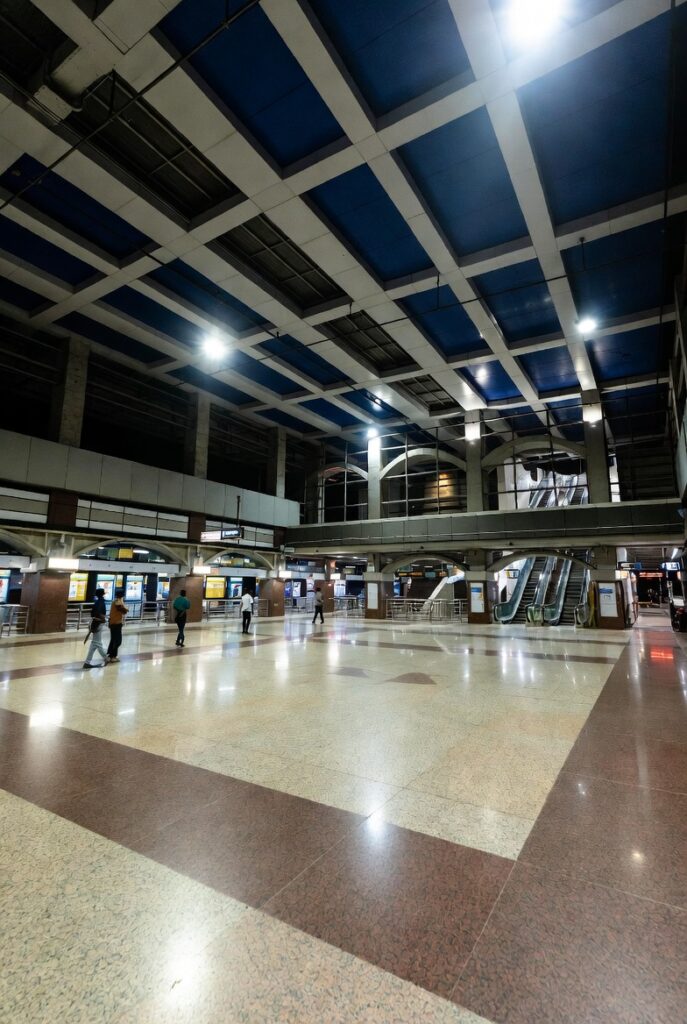
Over the years, the station has evolved with upgraded technology such as automated fare collection gates, better lighting, improved ventilation systems, and enhanced surveillance measures. Despite handling thousands of passengers per hour, the station remains well-organized due to continuous improvements by DMRC. Today, Rajiv Chowk stands as a symbol of Delhi’s progress—an example of how infrastructure, innovation, and urban planning can together transform everyday life for millions.
Why Rajiv Chowk Is the Heart of Delhi Metro
Rajiv Chowk isn’t just another metro station—it is the pulsating heart of the entire Delhi Metro network. If you imagine the city’s metro system as a living organism, Rajiv Chowk would be the central artery, pumping passengers in every direction, keeping the flow of urban mobility alive. But what exactly makes it so important? The answer lies in the unique blend of its connectivity, location, accessibility, and the sheer number of people it serves every single day.
First, the station’s role as a major interchange automatically places it in a position of importance. It connects two of Delhi’s busiest lines: the Yellow Line (running from Samaypur Badli to Millennium City Centre Gurgaon) and the Blue Line (stretching between Dwarka Sector 21 and Noida Electronic City/Vaishali). This dual-line connectivity creates a funnel through which travelers from nearly every zone of Delhi-NCR move. As a result, Rajiv Chowk becomes a central decision point for commuters—whether they are heading to office hubs, educational institutions, shopping centers, or residential areas.
Second, its location at Connaught Place amplifies its importance. CP is one of Delhi’s biggest economic engines—a business hub, financial district, entertainment hotspot, tourist attraction, and social hangout all rolled into one. From high-end fashion brands to decades-old eateries, from corporate offices to weekend street markets, everything converges here. And Rajiv Chowk Metro Station is the access gateway for all of it. Without this station, reaching CP would become chaotic, time-consuming, and inconvenient for millions.
Third, Rajiv Chowk’s ability to handle massive footfall daily is unmatched. Even during peak hours, when crowds test the station’s capacity, its systems remain functional and surprisingly efficient. DMRC’s constant upgrades—from wider corridors to additional ticket counters and improved signage—have helped the station maintain its status as the city’s busiest metro node.
Ultimately, Rajiv Chowk is not just central geographically—it’s central emotionally, economically, and socially. It represents Delhi’s energy, movement, and constant buzz. Anyone who has passed through its vibrant tunnels knows that the station is practically a city landmark in itself.
Location and Geographical Importance
The geographical importance of Rajiv Chowk Metro Station goes far beyond its spot on the map. Nestled right beneath Connaught Place—Delhi’s iconic commercial and cultural circle—it sits at the geographical heart of New Delhi. If you were to draw an imaginary map of the city, Rajiv Chowk would fall almost exactly at the center, like a bullseye. This centrality isn’t just symbolic; it directly influences how people travel, work, shop, socialize, and explore the city. Its location is so strategic that it practically acts as Delhi’s “meeting point”—a place where people from all directions converge before dispersing again like rivers branching from a lake.
Because of this prime positioning, Rajiv Chowk naturally evolved into a transportation powerhouse. Travelers moving between North Delhi and South Delhi, or between the western corridors of Dwarka and the eastern stretches of Noida, often find themselves passing through this station. Delhi Metro’s planners deliberately placed the interchange here because any other location would have disrupted the flow of the city’s transportation ecosystem. It is the ideal spot to connect major business districts, residential zones, and cultural landmarks without forcing commuters to take long, winding routes.
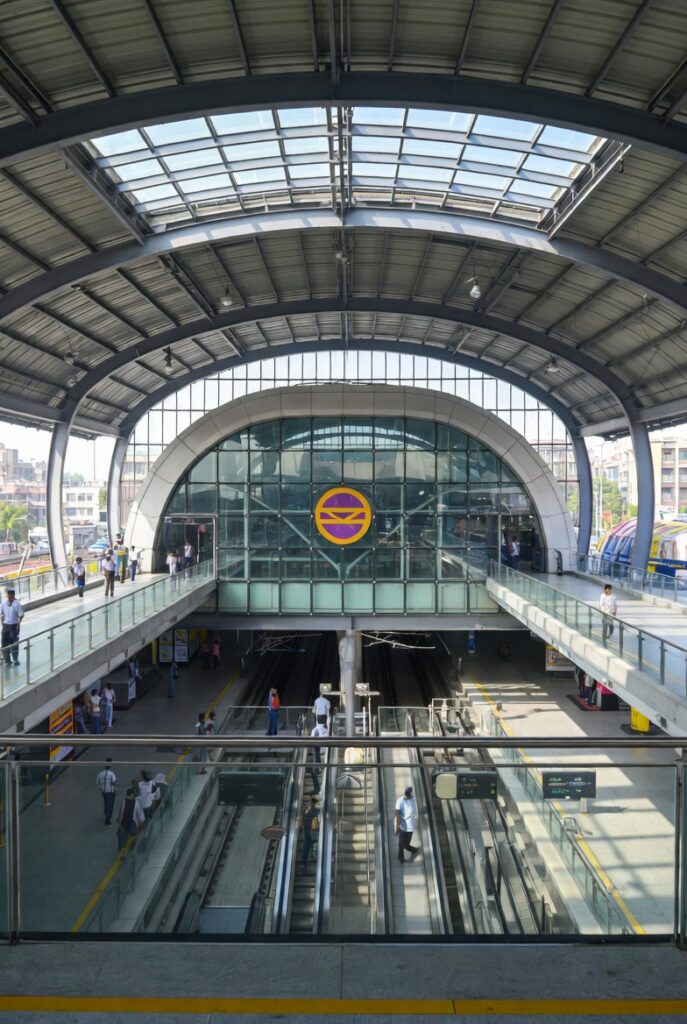
The area above the station—Connaught Place—further enhances its significance. CP is not just any marketplace; it is one of Delhi’s oldest and most visited destinations. Government offices, multinational corporate buildings, boutiques, cinemas, banks, cafés, and restaurants are densely packed around the station. This means that Rajiv Chowk Metro Station doesn’t just serve daily commuters; it also serves tourists, shoppers, students, and professionals who all converge here for different purposes.
Moreover, its proximity to major roads like Janpath, Barakhamba Road, Kasturba Gandhi Marg, and Sansad Marg ensures seamless integration with Delhi’s bus, auto, taxi, and even cycling routes. Whether someone is heading to India Gate, Jantar Mantar, or a corporate office in CP, Rajiv Chowk acts as the anchor point. Its connectivity is so efficient that many Delhiites prefer using the metro over driving simply because Rajiv Chowk makes the city feel smaller, more accessible, and easier to navigate.
This perfect blend of geography, urban design, and commuter convenience is what transforms Rajiv Chowk into the hub that keeps Delhi moving every single day.
Pingback: ltt stationI Lokmanya Tilak Terminus (LTT) Mumbai Traveler 1