Introduction
Vijayawada Junction Railway Station stands as one of India’s most dynamic and strategically significant railway hubs, connecting millions of passengers across the country every single year. With a history deeply rooted in the growth of Southern and Eastern railway corridors, this iconic station has evolved into a powerhouse of transportation, logistics, and travel convenience. Serving as a central node for the South Central Railway zone, Vijayawada Junction not only holds operational importance but also represents cultural and economic movement in and around Andhra Pradesh. As more travelers, commuters, tourists, and transport operators rely on its extensive network, the station continues to modernize, expand, and elevate its services to meet modern expectations. Whether someone is passing through, beginning their journey, or arriving at the bustling city of Vijayawada, this railway station leaves a lasting impression through its organization, accessibility, and undeniable energy. In this article, we dive deep into its origins, structure, services, modernization journey, and the irreplaceable role it plays in India’s railway ecosystem.
The Historical Evolution of Vijayawada Junction
Vijayawada Junction did not become a leading railway super-hub overnight. Its journey spans over a century, shaped by economic demands, expanding transport networks, and India’s ambition to construct a seamless nationwide rail system. When the station was initially developed during the British colonial period, its geographical location played a major role in determining its importance. Positioned on the banks of the Krishna River—one of the region’s most crucial waterways—the city naturally became an intersection for trade, movement, and cultural exchange. The rail system adopted this strategic advantage, making Vijayawada an essential link between Chennai, Kolkata, Hyderabad, and later, major western corridors. Over the decades, multiple expansions, track additions, and infrastructural upgrades fueled its transformation from a modest stopover to a full-fledged junction overseeing one of the densest rail routes in India. As economic activity surged and passenger demand multiplied, Vijayawada Junction embraced modernization, electrification, and operational restructuring. Today, its past forms the foundation of its identity—a station shaped not only by trains and tracks but also by the constant flow of people it serves.
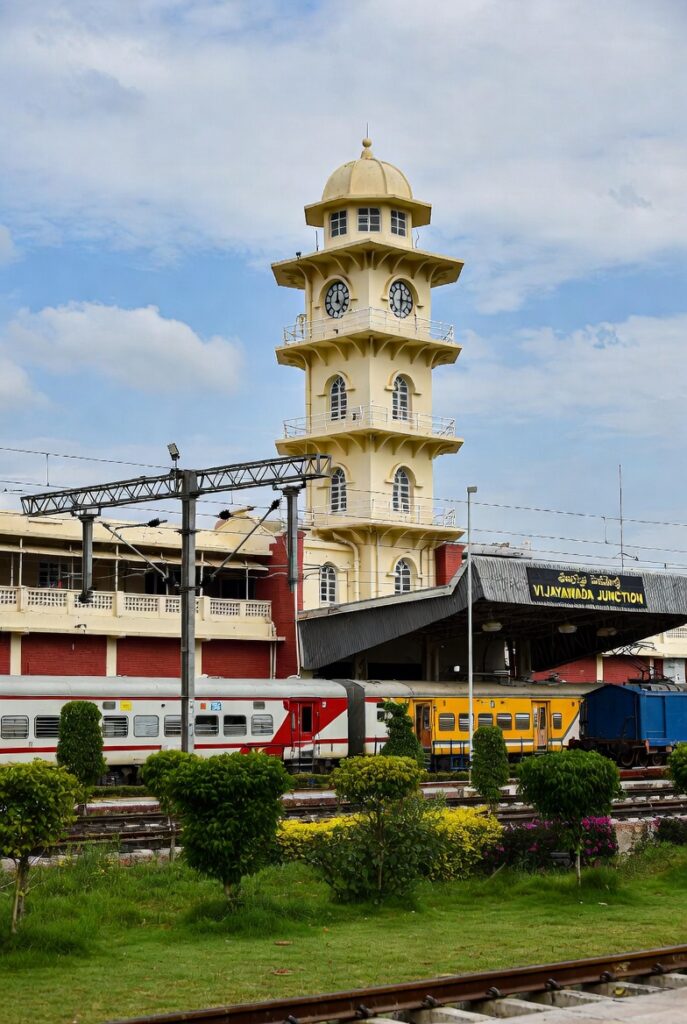
I. The Genesis: Tracing the Historic Tracks of Bezawada (Approx. 300 words)
The story of Vijayawada Junction is inseparable from the history of Indian rail expansion during the colonial era. The station, initially known by its former name, Bezawada, was founded not just on geographical convenience but out of sheer strategic necessity.
The British Rail Imperative
Prior to the late 19th century, railway construction was piecemeal. However, by the 1880s, the British administration recognized the critical need to link the major presidencies and ports. It was this vision that placed Bezawada squarely on the map. The actual station structure came into being around 1888, marking the connection of the Southern Maharatta Railway’s eastward route with other existing lines.
The true transformation into a junction began in 1889 when the Nizam’s Guaranteed State Railway extended its line from Secunderabad to Bezawada. This move instantaneously converted the modest station into a significant tri-junction, opening up vital commerce routes between the princely state of Hyderabad and the eastern coast.
The North-South Lifeline
The definitive milestone arrived on November 1, 1899, with the completion of the broad-gauge line connecting Bezawada and Chennai (Madras). This single stretch of track was revolutionary, completing the major north-south artery of the subcontinent. Suddenly, the possibility of seamless rail travel between Chennai, Mumbai, Howrah (Kolkata), New Delhi, and Hyderabad became a reality, with Vijayawada as the essential fulcrum.
After India’s independence and the subsequent nationalization of rail companies in 1950, the station became the headquarters of the Vijayawada Division. In 1966, the formation of the South Central Railway (SCR) zone saw the division merged into this new entity. These historic tracks cemented Vijayawada’s destiny: it was destined to be a key nerve centre, a place where history’s lines converged with the future’s promise.
II. The Operational Colossus: Decoding India’s Fourth Busiest Hub (Approx. 550 words)
To understand Vijayawada Junction is to grasp the sheer scale of its daily operations. It holds the prestigious NSG-1 (Non-Suburban Grade-1) status and is frequently cited as the fourth busiest railway station in India after giants like Howrah, Kanpur, and New Delhi. The complexity of managing this traffic flow is staggering, driven by its unique location as the meeting point of the Howrah–Chennai and New Delhi–Chennai main lines.
The Daily Rhythm of the Rails
Every 24 hours, BZA hosts a phenomenal volume of traffic. The station caters to approximately 1.40 lakh (140,000) passengers daily and manages the movement of over 360 trains. This includes nearly 200 express and passenger trains halting or originating here, alongside approximately 170 freight trains that pass through or are staged for changeovers.
The station boasts 10 major platforms and 24 tracks, a sprawling infrastructure designed to handle trains with 24 coaches or more. Platform No. 10 is dedicated to long-distance services, while Platform No. 7 holds the distinction of being one of the longest in the entire South Central Railway zone, reflecting the necessity of accommodating multiple simultaneous train operations. The sheer volume of trains and the critical intersection of high-speed passenger corridors with heavy-duty freight routes make BZA a logistical marvel.
The Nerve Centre: Route Relay Interlocking (RRI)
The true complexity of BZA lies beneath the surface, in the sophisticated technology required to manage the movements across its 24 tracks. Vijayawada Junction houses one of the largest and most complex Route Relay Interlocking (RRI) systems in the country.
RRI is the technological brain of the junction. It is a highly automated signaling and point control system designed to ensure absolute safety and maximal efficiency. It operates on an essential principle of railway safety: once a route is set for a train (e.g., from an entry point to a specific platform), all conflicting routes are automatically locked out, preventing any simultaneous movement that could lead to a collision or derailment.
The RRI cabin at Vijayawada monitors the entire yard complex. Due to the high density of traffic—where minutes often separate massive goods carriers from high-speed express trains like the Vande Bharat or Duronto—the RRI system must execute thousands of safe switching and signalling decisions every day. Any modernization or maintenance of this system is a mammoth task, often requiring short-term operational shutdowns to ensure long-term, fail-safe operation. The system is the invisible genius that keeps the Southern Crossroads ticking with punctuality and security.
Maintenance and Logistics Hub
BZA’s role extends beyond passenger handling. It is a major logistical hub for the SCR, housing both a Diesel Loco Shed and a crucial Electric Loco Shed. These sheds are vital for maintenance, repair, and stabling of the massive fleet of locomotives required for the heavy traffic passing through. Locomotives like the WAG-7, WAP-4, and WAP-7 are routinely maintained here, powering the freight and passenger trains that connect the coastal region to the interior. The presence of these maintenance facilities further underscores BZA’s strategic importance as a self-sufficient operational nexus.
III. The Passenger Portal: Amenities and the Modern Experience (Approx. 450 words)
The demands of over 140,000 daily passengers necessitate a continuous focus on modernization and amenities. Vijayawada Junction has aggressively embraced infrastructural upgrades, transforming the station from a purely functional transit point into a modern, passenger-centric facility.
Accessibility and Comfort
Addressing the sheer size of the station, significant investments have been made in passenger circulation. The platforms are interconnected by a massive, approximately 490-meter-long foot over bridge (FOB), connecting all 10 platforms and minimizing walking distances. Furthermore, accessibility is prioritized through multiple lifts (elevators) and escalators installed across various platforms, ensuring easy access for senior citizens, people with disabilities (Divyangjan), and those carrying heavy luggage. The station also features Braille signage and accessible facilities, reflecting a commitment to inclusive travel.
Cleanliness, Certification, and Connectivity
Vijayawada Junction has historically ranked highly in national cleanliness surveys. It earned the ‘Eat Right’ certification from the Food Safety and Standards Authority of India (FSSAI), recognizing its commitment to top hygiene and food safety standards across its diverse eateries.
The station is also a beacon of modern connectivity, providing free high-speed Wi-Fi (RailWire) for travelers. Facilities like Executive Lounges, spacious waiting halls, retiring rooms, and dedicated cloakrooms ensure that passengers can rest comfortably during long layovers. The modernization extends to safety, with advanced CCTV surveillance covering the platforms and concourse areas.
The Taste of Vijayawada
No journey through BZA is complete without sampling the local food culture. Vijayawada is famous for its vibrant street food and regional delicacies, many of which can be enjoyed right on the platform. While modern chains like KFC and Haldiram’s have established a presence, the heart of the station food scene lies in the local specialties. The famous tangy Pulihora (tamarind rice), spicy Mirchi Bhajji (chilli fritters), and other Andhra regional snacks are platform staples. This blend of multinational outlets and authentic local flavor adds a unique culinary dimension to the passenger experience, making the station a memorable stop.
IV. Economic Engine and Cultural Gateway (Approx. 400 words)
Vijayawada Junction’s influence radiates far beyond its perimeter, acting as a crucial economic linchpin and a cultural gateway for the entire Andhra region.
The Commerce Corridor
The city of Vijayawada is strategically located on the banks of the Krishna River, forming a significant commercial nexus in Andhra Pradesh. The railway station is instrumental to this identity, supporting the movement of agricultural produce, manufactured goods, and raw materials. The massive freight traffic handled by the division underscores its role as a key logistical corridor linking the hinterland with the vital ports and industrial zones of the Eastern Coast.
The connectivity provided by BZA—to metropolitan areas like Chennai, Hyderabad, and Kolkata—stimulates trade, travel, and industrial investment across the region. The high revenue generated by the station (exceeding ₹500 crore annually, which earned its NSG-1 status) is a direct reflection of its irreplaceable contribution to both the state and the South Central Railway’s financial health.
Gateway to Faith and Culture
Culturally, BZA is the primary access point for millions of pilgrims and tourists. It serves as the gateway to the sacred Kanaka Durga Temple, situated atop Indrakeeladri Hill, a structure visible from parts of the city. Furthermore, its proximity to Amaravati, the historic and proposed capital region, ties the junction to both ancient history and modern political significance.
The ceaseless stream of people—students heading to universities, business travelers, pilgrims, and families—makes the station a vibrant microcosm of Indian life. The language, the food, and the distinct local hospitality experienced here offer the first true taste of Andhra culture for those arriving from other states.
The story of Vijayawada Junction is one of relentless growth, and its next chapter promises an even more radical transformation. The station has been identified for major redevelopment under the ambitious Amrit Bharat Station Scheme, a national initiative aimed at modernizing India’s most important railway hubs.
The ₹946 Crore Vision
The redevelopment project, with an investment outlay of over ₹946.60 crore, is designed to future-proof the station for the next four decades. The master plan aims to handle a daily footfall of up to two lakh (200,000) passengers and a peak hour traffic of 20,000, addressing the projected capacity needs up to the year 2065.
Key components of this massive overhaul include:
- Expanded Terminals: Construction of two multi-storey terminal buildings on the East and West sides, creating distinct systems for passenger arrivals and departures, separating the flow for vastly improved circulation.
- Increased Capacity: The total station area is set to expand dramatically, with plans to increase the number of platforms from 10 to 12.
- Multi-Level Parking (MLCP): A significant increase in parking capacity from the current few hundred vehicles to space for over 1,700 vehicles, addressing the persistent issue of traffic congestion outside the main entrance.
- Commercial Development: The plan incorporates a seven-storey commercial block featuring retail, food courts, and office space, integrating the station into the urban landscape and boosting non-fare revenue.
- Green Initiatives: The project adheres to modern green building protocols, including extensive use of solar energy (the station already pioneered solar panel installations), rainwater harvesting, and sustainable design elements.
The Role of Satellite Stations
Crucially, the massive redevelopment work is being supported by the development of nearby satellite stations like Gunadala and Rayanapadu. These smaller hubs will handle diverted train services during the construction phase, ensuring that the operational continuity of the vital north-south corridor remains uninterrupted. This strategic approach ensures that even as the junction undergoes its most significant transformation, its essential function as the nation’s key crossroads is protected.
Conclusion: The Junction That Connects India (Approx. 100 words)
Vijayawada Junction is far more than concrete and steel; it is a vital artery of the Indian economy and a testament to modern engineering conquering logistical challenges. From its humble 19th-century origins to its current status as an NSG-1, 10-platform colossus, BZA stands as a symbol of connectivity. It is a hub where every passing train is a reminder of the nation’s vastness, and every passenger is a thread woven into India’s ongoing story. As it embarks on its monumental redevelopment, BZA reaffirms its role not just as the gateway to Andhra Pradesh, but truly, as the junction that connects India.